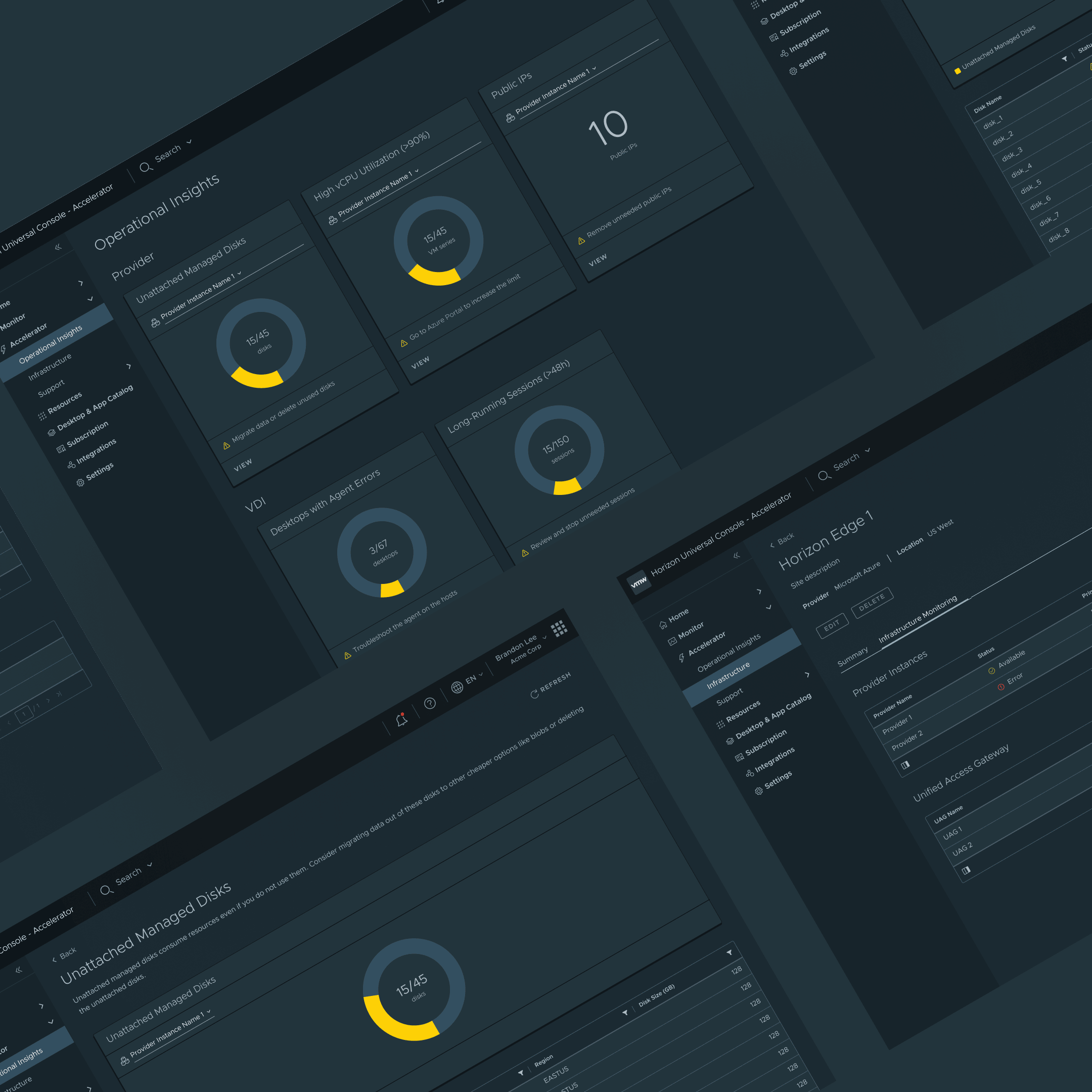
Context
VMware partnered with the company I worked from to bring observability and monitoring technology inside Horizon, their flagship VDI platform. I was brought in from the partner side to lead the UX of the integration.
The brief was simple to state and hard to execute. There was no prior UI to inherit from the partner side. The design work was new from functional requirements alone. VMware's Clarity design system was the foundation, which I picked up from scratch and iterated in during the engagement. Real technical constraints shaped what was actually possible. API latency was the one that mattered most.
A partner's tech lands inside a flagship product looking foreign by default. The work is making that foreignness disappear without losing what it does well.
Some specifics are held back. The diagnostic stands.
Approach
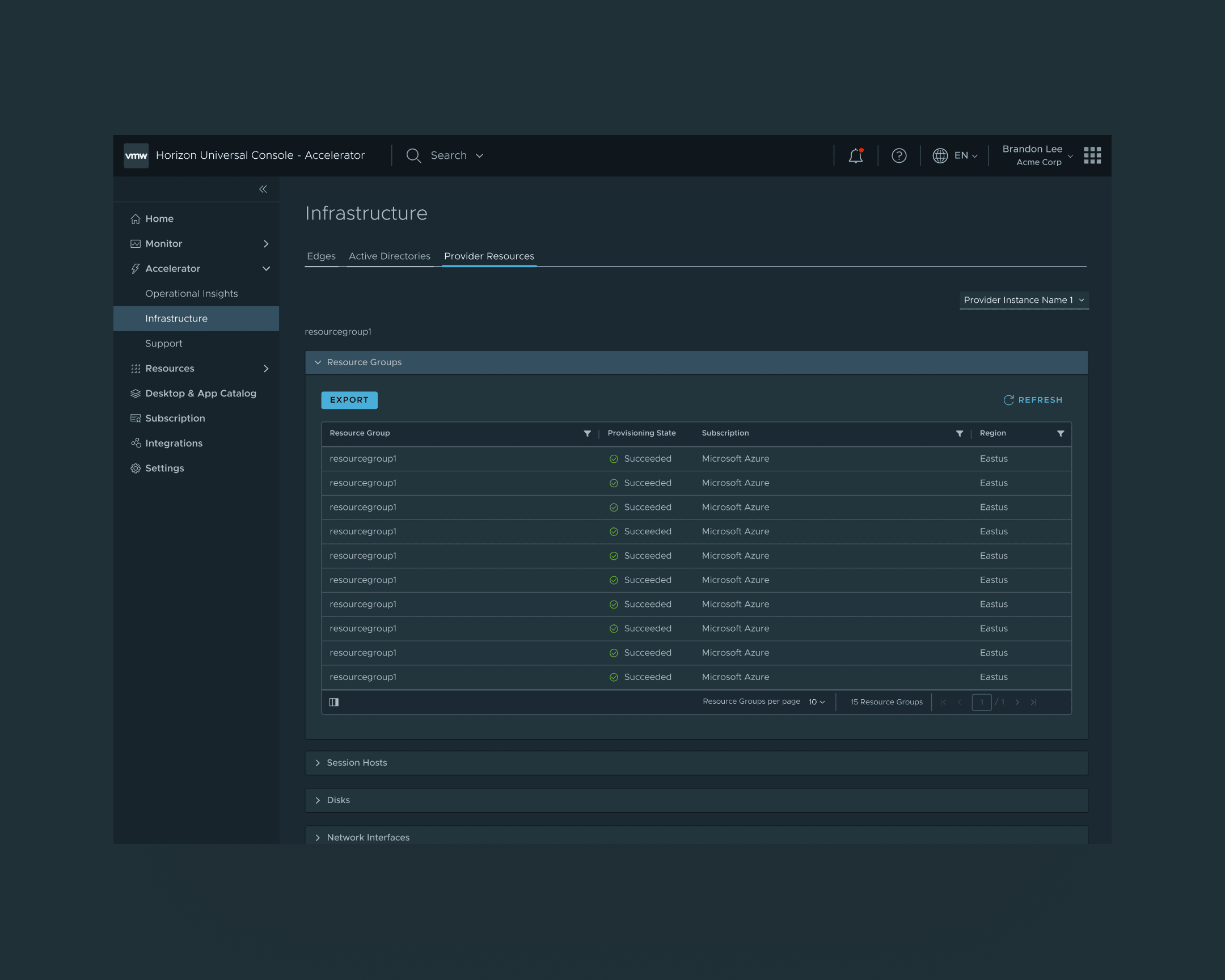
The integration had to work on the console admins open every morning: the Monitor layer where fleet health, user sessions, and deployments live side by side. The question wasn't "where does the new capability go?" It was "which surface do administrators already trust, and how does the new capability disappear into it?" The answer was to land the new functionality on Infrastructure as an extension of what admins already used, not to build a new destination.
A concrete example. The Provider Resources view carried eight resource categories per provider instance (Resource Groups, Session Hosts, Disks, Network Interfaces, Virtual Networks, Storage Accounts, Availability Sets, Public IP Addresses), each with its own status requiring its own API call, multiplied by however many Azure provider instances the customer had connected. The first instinct was an aggregate view that showed every instance and every category at once. That didn't survive the API-cost math. The shipped solution was two-level scope reduction: a provider-instance dropdown at the top, then accordion-per-category inside. Expand the category that matters, the call fires then. Technical constraint and real admin intent collapsed into the same design.
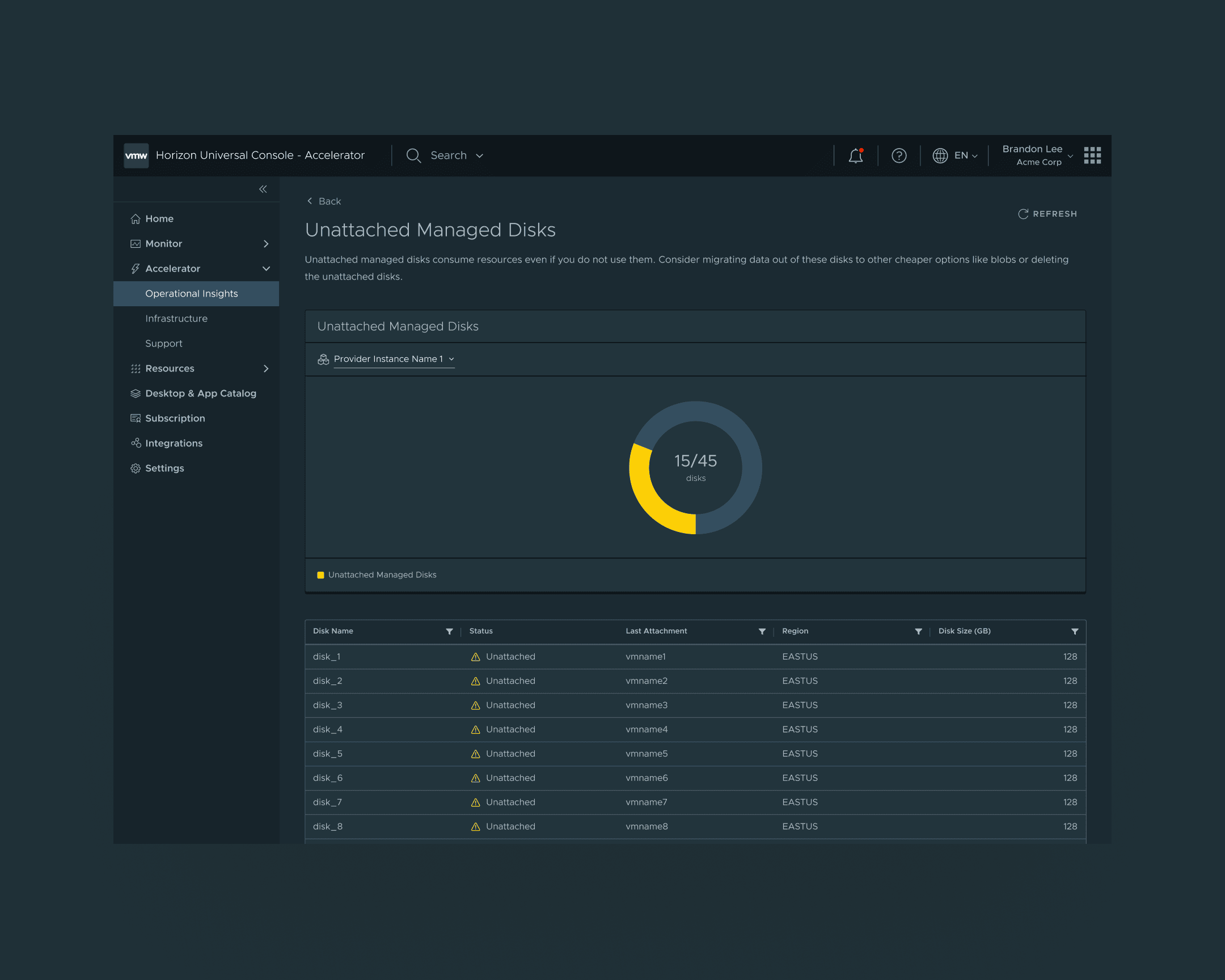
Operational Insights carried the parallel argument. Same tech, different job: surface cost waste the admin didn't know was there. The Unattached Managed Disks view named the leak (15 of 45 disks), said why it mattered in one line, pointed at the action. Same chrome as Infrastructure, different decision: the capability earned its keep by showing the admin money they were already paying.
Impact
The Fortune 500 sporting apparel operator was being onboarded onto the integration while the design team was still wrapping up. No gap between design-complete and enterprise-live, a pace unusual for F500 VDI rollouts, where phased adoption is typical.
What this case taught me
When partner tech lands inside a flagship product, the integration question isn't "where does the new brand go?" It's "which surface do users already trust, and how does the new capability disappear into it?" The measure of success is that the seam becomes invisible, not that the new capability gets its own stage.